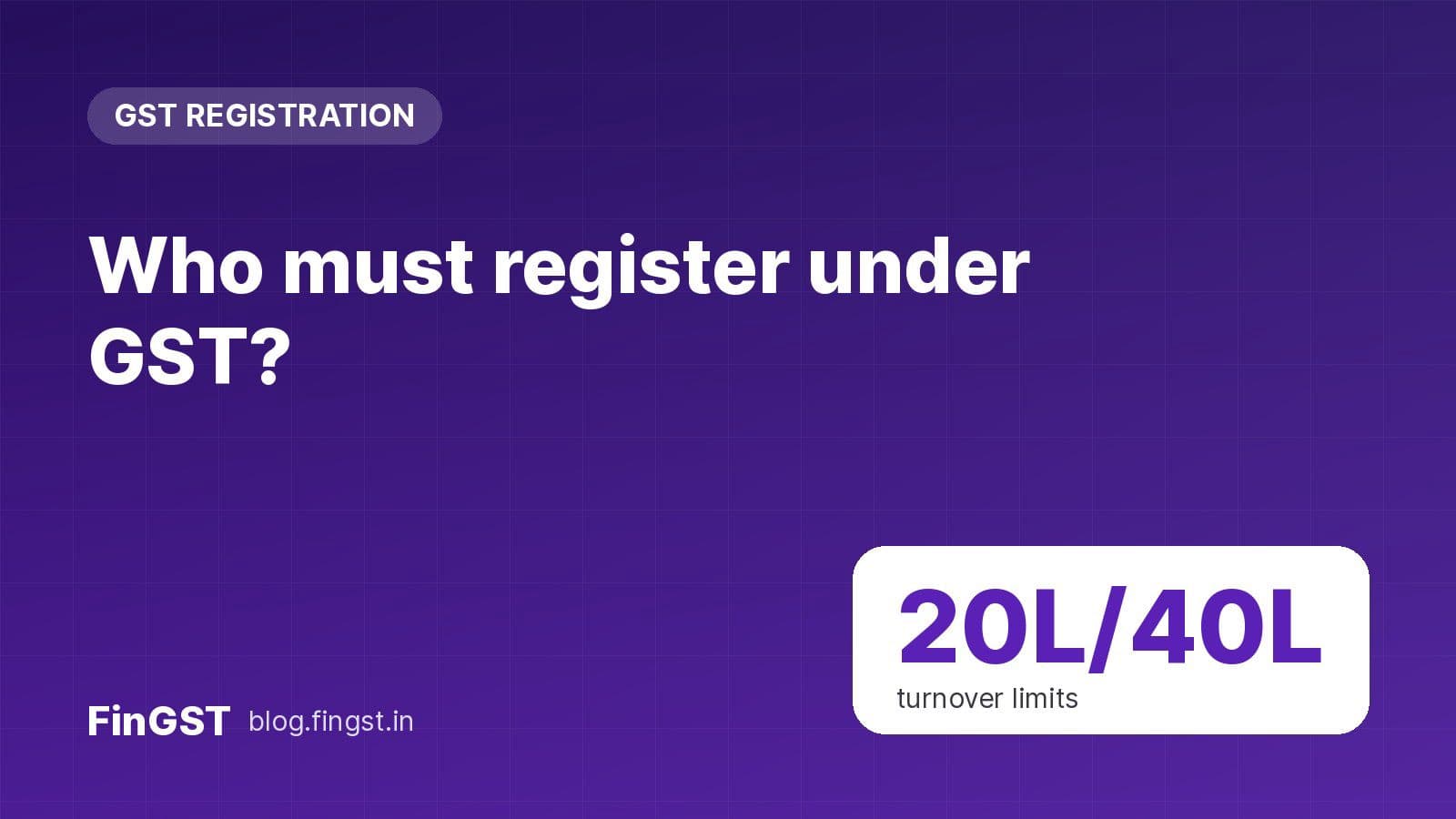
The turnover limits
| Business type | Most States | Special-category States* |
|---|---|---|
| Only goods | ₹40 lakh (some States kept ₹20 lakh) | ₹20 lakh or ₹10 lakh |
| Services, or goods and services | ₹20 lakh | ₹10 lakh |
*Manipur, Mizoram, Nagaland and Tripura use the ₹10 lakh limit. Several other North-Eastern and hill States follow their own notified limits. Check your State's limit on the portal.
How to count aggregate turnover
Aggregate turnover is calculated across India, on one PAN. It includes:
- taxable supplies,
- exempt supplies,
- exports,
- inter-State supplies.
It excludes GST itself and inward supplies taxed under reverse charge.
Example: A consultant earns ₹12 lakh from Indian clients and ₹10 lakh from foreign clients. Aggregate turnover is ₹22 lakh, which is above ₹20 lakh, so registration is required.
When you must register regardless of turnover
- Inter-State supply of goods. Inter-State supply of services below the threshold is exempt from compulsory registration.
- Selling goods through e-commerce operators, subject to the relaxation for small sellers who supply only within the State.
- Casual taxable persons and non-resident taxable persons.
- Persons who must pay tax under reverse charge.
- TDS deductors and TCS collectors (e-commerce operators).
- Input service distributors.
- Agents supplying on behalf of registered principals.
Voluntary registration
You can register even below the limit. It lets you claim ITC and work with larger B2B clients who want GST invoices. But once registered, you must file returns every month or quarter, even nil returns.
Recent changes that make it easier
- Rule 14B (from 1 November 2026): e-commerce sellers can register in a State using the platform's approved warehouse.
- Simplified registration under Rule 14A for small taxpayers, with faster approval.
- Amendments approved on submission for many core fields.
Apply 30 days before you expect to cross the limit, so you can issue GST invoices from day one.
Documents required
| For | Documents |
|---|---|
| Proprietor | PAN, Aadhaar, photo, mobile and email |
| Partnership / LLP | Firm PAN, partnership deed or LLP agreement, partners' PAN, Aadhaar and photos |
| Company | Company PAN, certificate of incorporation, MoA and AoA, directors' PAN, Aadhaar and photos, board resolution |
| Place of business | Electricity bill or property tax receipt, plus a rent agreement or consent letter if not owned |
| Bank | Cancelled cheque, passbook first page or bank statement |
| Signatory | Authorisation letter, plus DSC for companies and LLPs |
Online GST registration, step by step
- On the GST portal, choose New Registration (Form GST REG-01).
- Part A: enter your PAN, mobile and email, and verify the OTPs to get a TRN.
- Part B: log in with the TRN and fill in business details, promoters, the authorised signatory, the place of business, HSN/SAC codes and bank details.
- Aadhaar authentication: you may be asked for biometric authentication at a GST Suvidha Kendra. See how to book a GSK appointment.
- Submit with EVC (proprietors and firms) or DSC (companies and LLPs). You get an ARN.
- Approval: usually within 7 working days, or up to 30 days if a physical verification is ordered.
- If the officer raises a query (REG-03), reply in REG-04 within 7 working days.
- Once approved, download your REG-06 certificate.
After registration
- Display your GSTIN at your place of business.
- Issue tax invoices with your GSTIN.
- File GSTR-1 and GSTR-3B (monthly or QRMP).
- If eligible, consider composition (turnover up to ₹1.5 crore for goods, ₹50 lakh for services).
Common rejection reasons
- The address proof does not match the address entered.
- A blurry or incomplete rent agreement, or a missing NOC.
- Aadhaar authentication not completed in time.
- The wrong HSN/SAC or business constitution.
FAQs
Is GST registration free? Yes. There is no government fee.
How long does GST registration take? About 7 working days, or up to 30 days if physical verification is required.
Can I register for GST without a shop? Yes. You can use your residence as the principal place of business, with the right address proof.