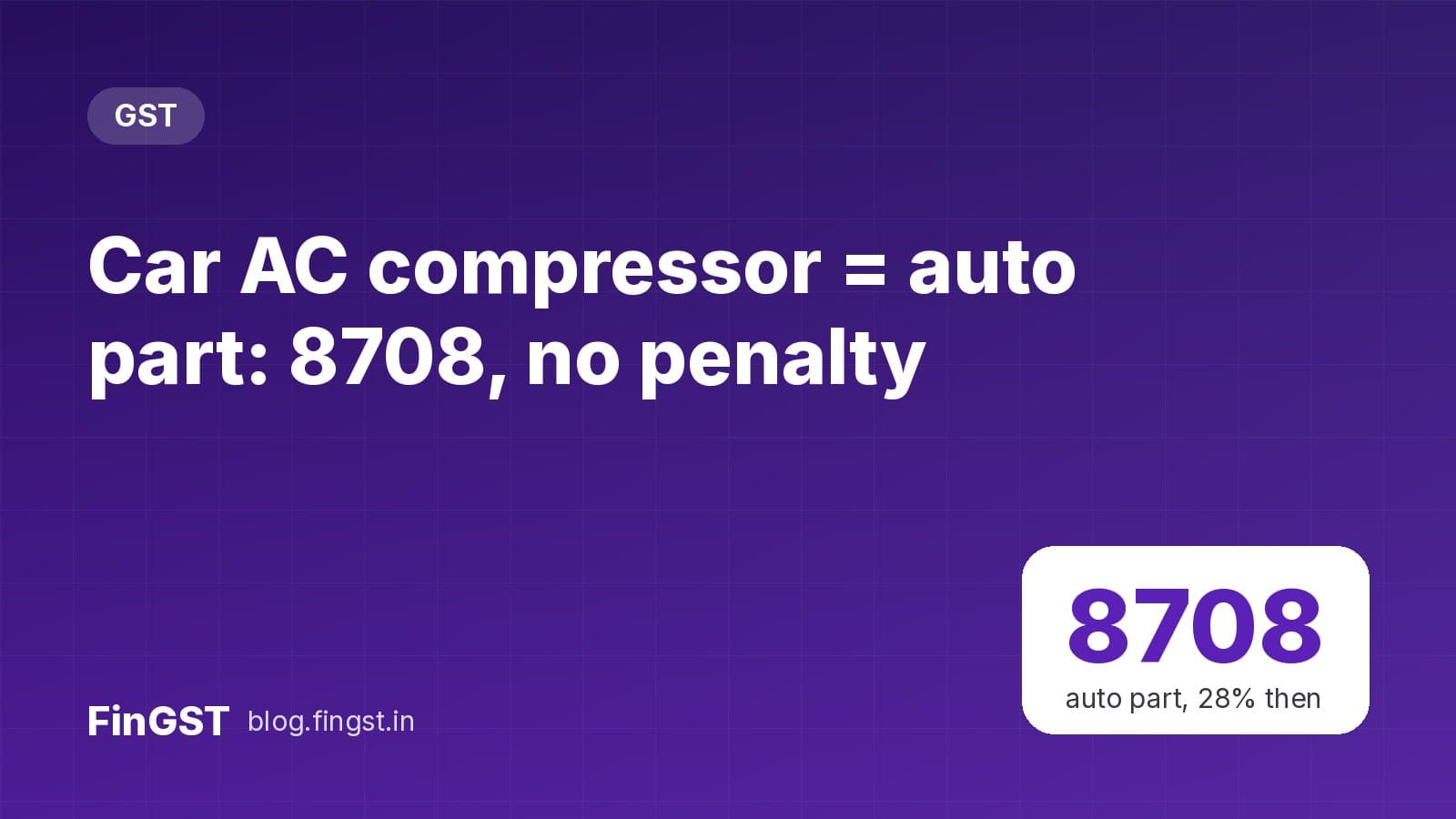
Classification disputes are among the costliest in GST, because the department often adds a Section 74 penalty equal to the tax. A Madras High Court ruling settles a long-running question on car AC compressors and also draws a line on penalties.
The case
Hanon Automotive Systems India Pvt. Ltd. v. Deputy Commissioner (Madras High Court, Justice C. Saravanan, common order of 9 February 2026, seven writ petitions, reported 23 November 2026):
- Hanon makes compressors for vehicle air-conditioners and supplies them to car makers, including Hyundai.
- It classified them under heading 8414 (compressors). From 15 November 2017 that meant 18% GST.
- The department said they are parts of motor vehicles under heading 8708 (8708 99 00), taxed at 28% at the time. It raised Section 74 demands with an equal penalty for FY 2017-18 to 2023-24 (orders of 15 March 2024).
What the court held
On classification, the department wins.
- Reading Section XVII Notes 2, 2(e) and 3 of the tariff together, the compressors fall in Chapter 87.
- They are designed specifically for automotive AC units, with no other use shown. That made them auto parts under 8708 99.
On penalty and time limit, the company wins.
- Hanon had used heading 8414 in good faith since 1997, and the department had accepted that for years.
- A bona fide classification view is not suppression with intent to evade.
- So the Section 74 orders were set aside. The officer must recompute tax under Section 73 (normal time limit, lower penalty) within six months, with a hearing limited to quantification.
What it means now
| Period | Effect |
|---|---|
| Up to 21 September 2025 | Vehicle-specific parts under 8708 generally attracted 28%; differential tax may be due |
| From 22 September 2025 (GST 2.0) | Most auto parts moved to 18%, narrowing such gaps. Check the current rate for your exact HSN |
Lessons for any classification dispute
- Document why you chose your HSN: technical specs, HSN explanatory notes, earlier rulings and any department acceptance.
- Disclose your classification clearly in invoices and returns. Openness is what defeats a "suppression" charge.
- If the department disagrees, contest the penalty and time limit separately from the rate. As here, you can lose on rate but still save the penalty and older years.
- Consider an advance ruling for new products. It binds the department for you.
Tip: "Sole or principal use" matters in the auto-parts chapter. If a part is built only for vehicles, expect it to be treated as an auto part, whatever its general description.