The new tax regime is the default. You pay under it unless you opt out. The slabs introduced in Budget 2025 continue for tax year 2026-27 under the Income-tax Act, 2025.
The slabs
| Taxable income | Rate |
|---|---|
| Up to ₹4 lakh | Nil |
| ₹4 lakh – ₹8 lakh | 5% |
| ₹8 lakh – ₹12 lakh | 10% |
| ₹12 lakh – ₹16 lakh | 15% |
| ₹16 lakh – ₹20 lakh | 20% |
| ₹20 lakh – ₹24 lakh | 25% |
| Above ₹24 lakh | 30% |
Add 4% health and education cess on the tax. A surcharge applies above ₹50 lakh and is capped at 25% under the new regime.
The ₹12 lakh rebate
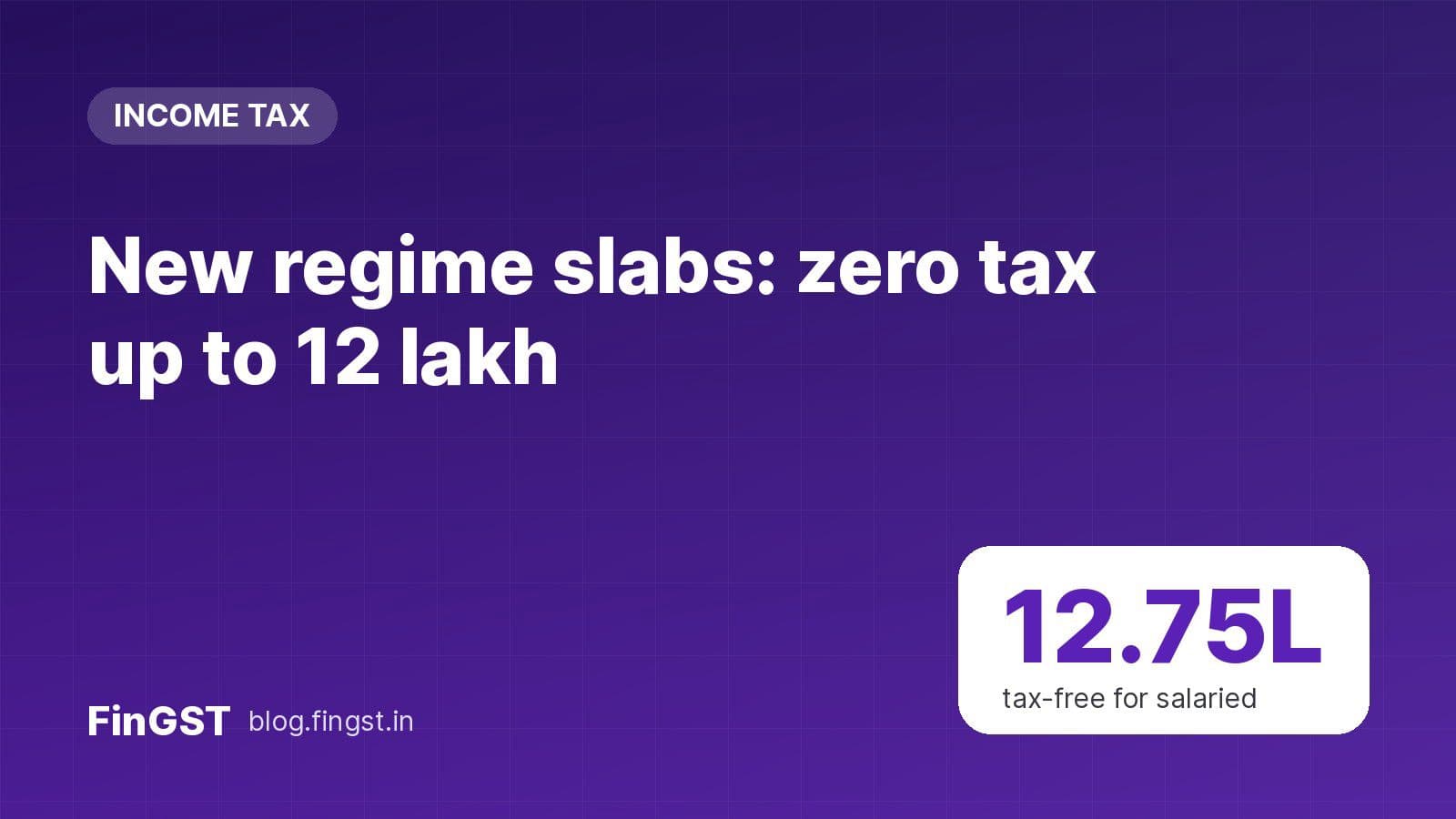
Resident individuals with taxable income up to ₹12 lakh get a rebate of up to ₹60,000, which brings their tax to zero.
Salaried people and pensioners also get a ₹75,000 standard deduction, so gross salary of up to ₹12.75 lakh is tax-free.
The rebate does not cover income taxed at special rates, such as short-term gains on listed shares or long-term capital gains. See our article on the rebate and capital gains.
Marginal relief just above ₹12 lakh
If taxable income is slightly above ₹12 lakh, the tax payable is capped at the amount by which your income exceeds ₹12 lakh.
Example: Taxable income is ₹12,10,000. Slab tax would be ₹61,500, but the excess over ₹12 lakh is only ₹10,000, so you pay ₹10,000 (plus cess).
Worked examples (salaried)
| Gross salary | Taxable (after ₹75,000) | Tax + cess |
|---|---|---|
| ₹10,00,000 | ₹9,25,000 | Nil (rebate) |
| ₹12,75,000 | ₹12,00,000 | Nil (rebate) |
| ₹15,00,000 | ₹14,25,000 | ₹97,500 |
| ₹20,00,000 | ₹19,25,000 | ₹1,92,400 |
| ₹30,00,000 | ₹29,25,000 | ₹4,75,800 |
Deductions that still work under the new regime
- standard deduction of ₹75,000,
- employer's NPS contribution up to 14% of salary,
- family pension deduction of ₹25,000,
- Agniveer Corpus Fund contribution.
Most other deductions, such as 80C, 80D, HRA and home-loan interest on a self-occupied house, are not available under the new regime.
Old regime slabs, for comparison
| Taxable income | Below 60 | 60 to 79 | 80 and above |
|---|---|---|---|
| Up to ₹2,50,000 | Nil | Nil | Nil |
| ₹2,50,001 – ₹3,00,000 | 5% | Nil | Nil |
| ₹3,00,001 – ₹5,00,000 | 5% | 5% | Nil |
| ₹5,00,001 – ₹10,00,000 | 20% | 20% | 20% |
| Above ₹10,00,000 | 30% | 30% | 30% |
Under the old regime the rebate is up to ₹12,500 (income up to ₹5 lakh) and the standard deduction is ₹50,000, but you keep deductions such as 80C (now Section 123 with Schedule XV), 80D, HRA and home-loan interest.
Surcharge
| Total income | Surcharge |
|---|---|
| ₹50 lakh – ₹1 crore | 10% |
| ₹1 crore – ₹2 crore | 15% |
| ₹2 crore – ₹5 crore | 25% |
| Above ₹5 crore | 37% old regime / 25% new regime |
New vs old: three salaries compared
Old regime figures assume 80C ₹1.5 lakh, 80D ₹25,000 (not at ₹10 lakh) and the ₹50,000 standard deduction. All figures include 4% cess.
| Salary | New regime | Old regime |
|---|---|---|
| ₹10 lakh | Nil | ₹75,400 |
| ₹15 lakh | ₹97,500 | ₹2,02,800 |
| ₹20 lakh | ₹1,92,400 | Higher, unless you claim large HRA and home-loan deductions |
For the full decision guide, see old vs new tax regime: how to choose.
Switching rules: salaried taxpayers without business income can choose a regime every year when they file. If you have business or professional income, you can switch back to the old regime only once.
FAQs
Did Budget 2026 change the tax slabs? No. The FY 2025-26 slabs continue for tax year 2026-27.
Is income up to ₹12 lakh tax-free? Yes, under the new regime, through the rebate (Section 156 of the 2025 Act, formerly 87A). It applies to normal-rate income only, not to special-rate capital gains.
Is the new regime compulsory? No. It is the default, but you can opt for the old regime.