Quick answer: The Income Tax Act, 2025 came into force on 1 April 2026 and replaces the Income Tax Act, 1961 from tax year 2026-27. Most rules are the same in substance. What changed is the numbering, the structure (many provisions moved into tables and schedules), and the "tax year" concept.
What actually changed
- Tax year replaces "previous year" and "assessment year". FY 2026-27 is now simply tax year 2026-27.
- The Act is shorter and uses tables. Long provisos and explanations were rewritten as tables and schedules.
- TDS was consolidated. The many separate TDS sections (193 to 194T) now sit in a small number of sections, with each payment type listed as a row in a table.
- Most rates and thresholds carried over. The slabs, the rebate and most deductions are the same in substance.
Section mapping: the ones people search for most
| What it covers | Income Tax Act 1961 | Income Tax Act 2025 |
|---|---|---|
| Tax year (replaces PY/AY) | Sec 2(9), 3 | Sec 3 |
| New tax regime for individuals | Sec 115BAC | Sec 202 |
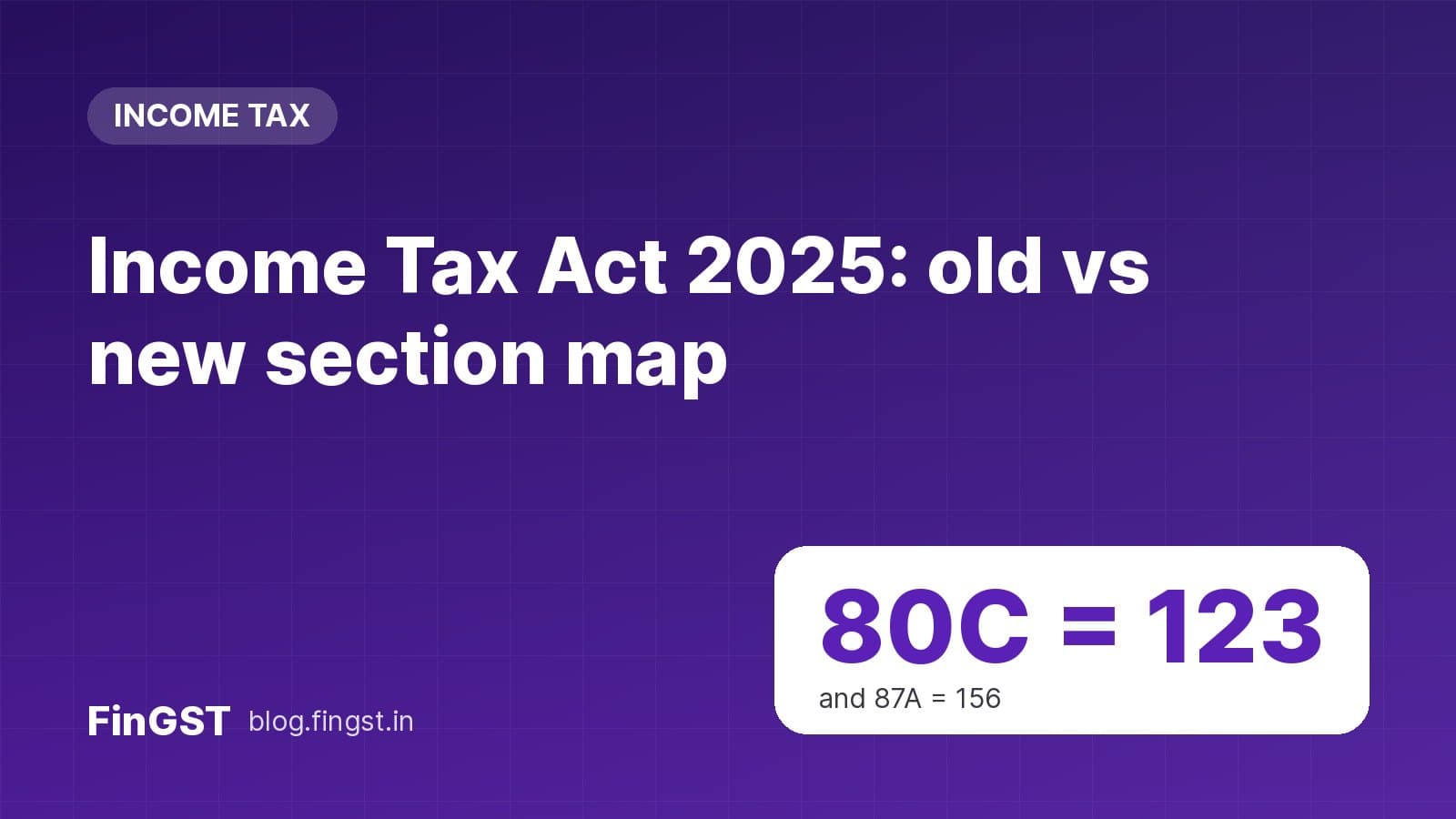
| Rebate (₹12 lakh, new regime) | Sec 87A | Sec 156 |
| 80C investments (PPF, ELSS, LIC, tuition fees, home-loan principal) | Sec 80C | Sec 123 read with Schedule XV |
| Filing the return of income | Sec 139 | Sec 263 |
| TDS on salary | Sec 192 | Sec 392 |
| TDS on other payments (interest, rent, contractors, professional fees, commission and so on) | Secs 193 – 194T | Sec 393 (payment-wise table) |
Tip: in the 2025 Act, 80C is not a long list in the section itself. The list of eligible investments sits in Schedule XV, so a quick search can make it look as if 80C was removed. It was not.
How the new TDS structure works
Under the 1961 Act, every type of payment had its own section, such as 194C (contractors), 194J (professional fees) and 194I (rent). Under the 2025 Act:
- Salary TDS is in Section 392.
- Most other resident payments are in Section 393, where each payment type is a serial number in a table that gives its rate and threshold.
In practice, a challan, Form 26Q or certificate that used to say "194J" now refers to the Section 393 entry for professional fees. The rates are covered in our TDS rate chart.
What stays the same for you
- Your slab rates and the ₹12 lakh rebate (see income tax slab FY 2026-27).
- The old vs new regime choice.
- Advance tax instalments (15 June, 15 September, 15 December, 15 March).
- The updated return (ITR-U) facility.
Which Act applies to which year?
- Up to FY 2025-26 (AY 2026-27): the 1961 Act. Returns, notices and assessments for these years still cite the old sections.
- From tax year 2026-27: the 2025 Act.
So for the next few years CAs will work under both Acts at once. Keep this mapping handy.
A checklist for CAs and finance teams
- Update section references in invoices, agreements and TDS workings.
- Update accounting software masters (TDS nature-of-payment codes).
- Re-train staff on the "tax year" terminology.
- Check the old section numbers in client engagement letters and tax audit templates.
- Before quoting any sub-section or table serial number, check it against the official text of the Act.
FAQs
When did the Income Tax Act 2025 come into force? On 1 April 2026.
Is 80C removed in the new Act? No. It is Section 123, and the eligible investments are listed in Schedule XV.
What is the new section for 87A? Section 156.
What happens to 194J, 194C and 194I? They are consolidated into Section 393 as table entries.
Do I file returns for FY 2025-26 under the new Act? No. FY 2025-26 (AY 2026-27) is governed by the 1961 Act.
Get alerts on CBDT notifications and new forms in the FinGST app.