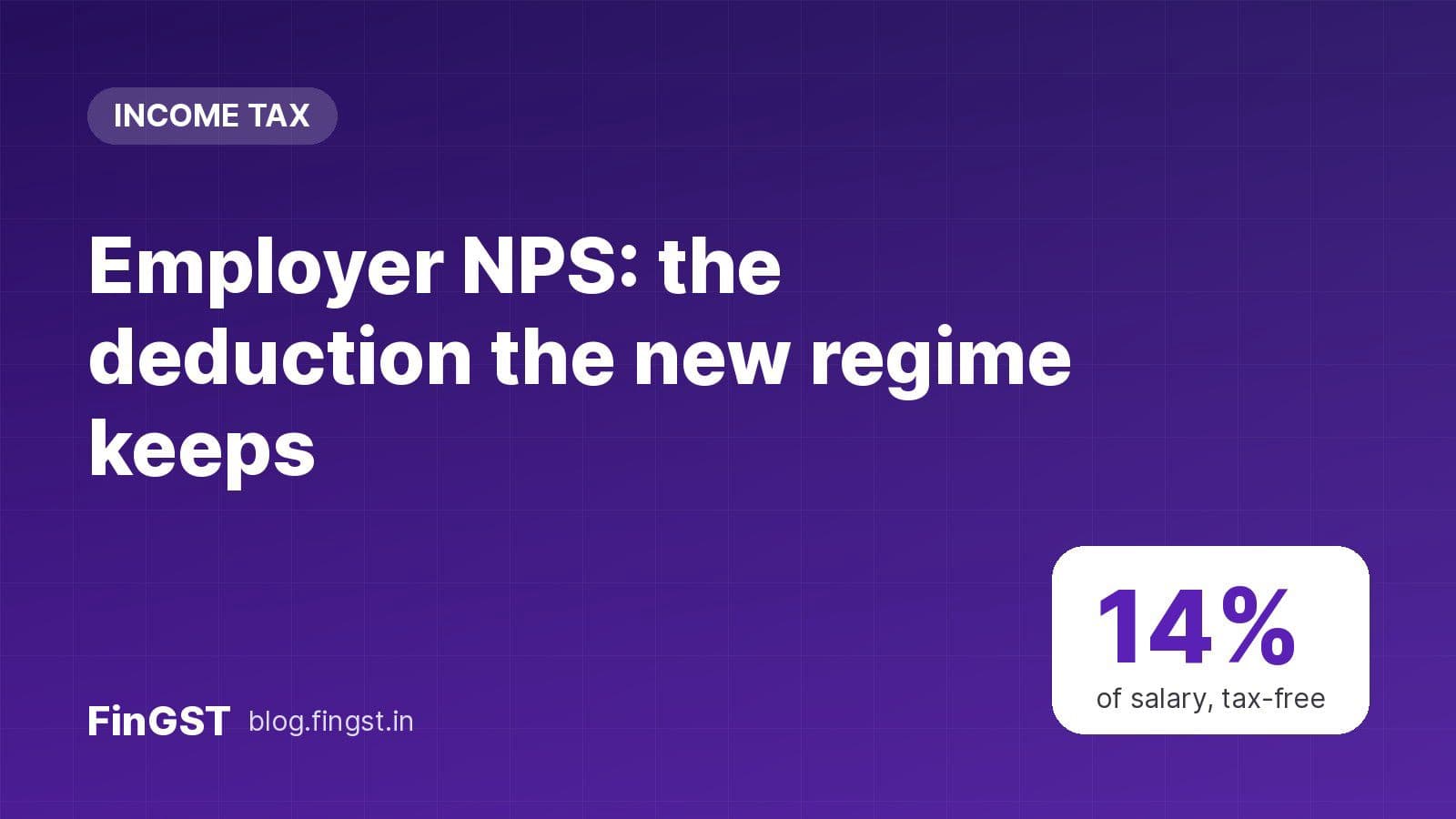
The new regime removed 80C, 80D, HRA and most other deductions. One that survives is the deduction for your employer's contribution to your NPS account. This was Section 80CCD(2) under the 1961 Act.
How much
| Regime | Deduction for employer NPS contribution |
|---|---|
| New regime | Up to 14% of basic salary + DA |
| Old regime | Up to 10% (14% for government employees) |
This is separate from the ₹75,000 standard deduction and from anything you contribute yourself.
The overall cap
Employer contributions to EPF, NPS and superannuation together are tax-free only up to ₹7.5 lakh a year. Anything above that, and the returns earned on it, is taxed as a perquisite.
Example
Basic + DA = ₹10 lakh a year. Total CTC = ₹20 lakh.
- Without NPS: taxable salary ₹19.25 lakh. New-regime tax is about ₹1,92,400.
- With employer NPS of 14% (₹1.4 lakh) carved out of the same CTC: taxable salary ₹17.85 lakh. Tax is about ₹1,63,300.
That's a saving of roughly ₹29,000 a year, and the ₹1.4 lakh goes into your retirement savings.
How to get it
- Ask HR whether the company offers corporate NPS. Most large employers do.
- Ask to restructure your CTC so that part of it is paid as the employer's NPS contribution. Your take-home pay drops, but your tax falls more.
- Open or link your PRAN.
- Make sure the contribution shows up in your Form 16 so the deduction is applied when TDS is calculated.
Things to know
- NPS money is locked in until 60, with partial withdrawals allowed for specific needs.
- At retirement, 60% can be withdrawn tax-free, and the rest buys an annuity that is taxed as income.
- Your own NPS contribution (the extra ₹50,000 under 80CCD(1B)) is not deductible under the new regime.