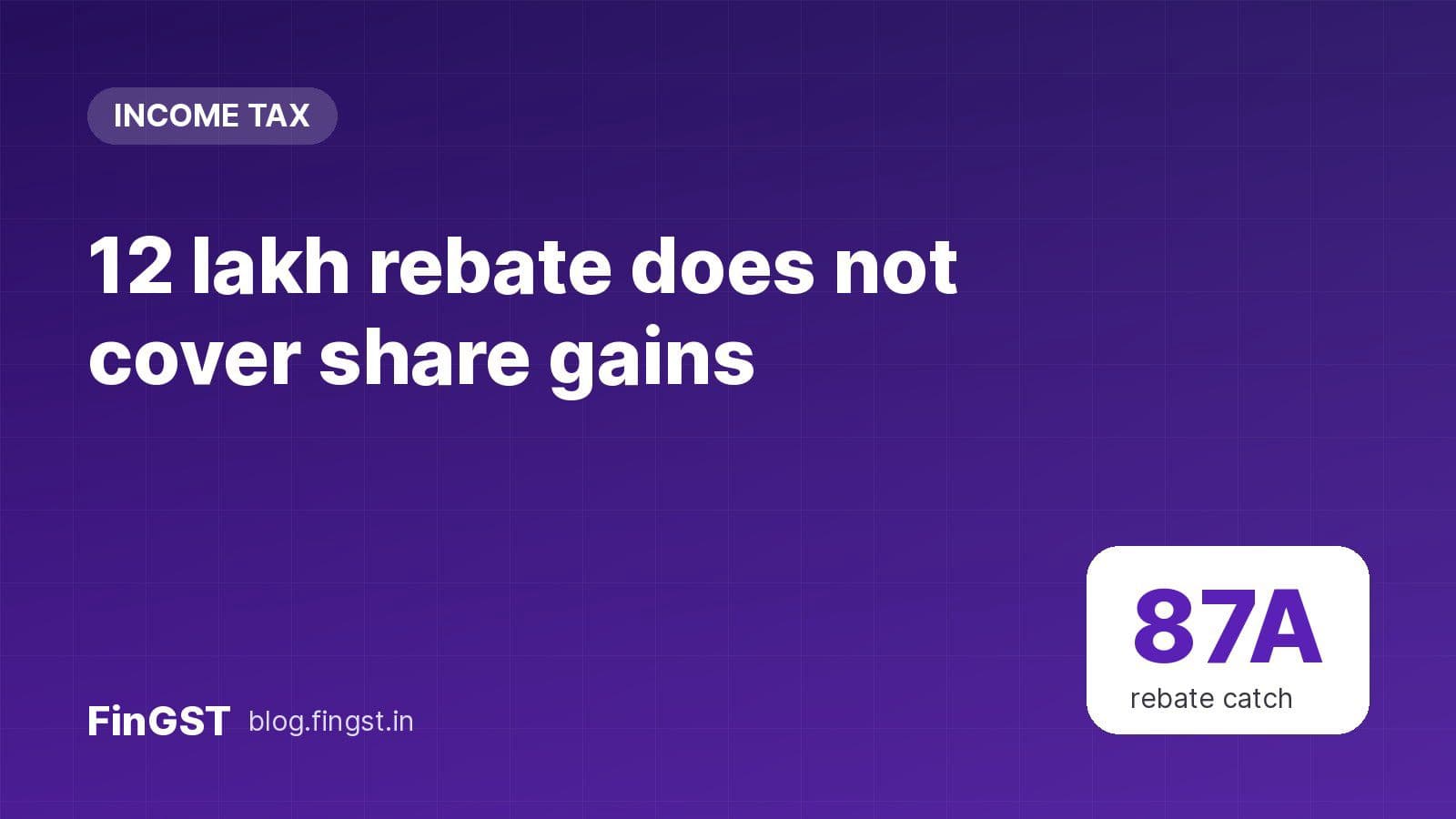
"Income up to ₹12 lakh is tax-free" is true only for income taxed at normal slab rates. Many small investors find out at filing time that their share-market gains are taxed even though their total income is under ₹12 lakh.
The rule
The rebate of up to ₹60,000 (Section 87A under the 1961 Act) applies to tax on normal income: salary, interest, rent and business income. It does not apply to tax on income taxed at special rates, such as:
- short-term gains on listed equity (20%),
- long-term gains on equity above ₹1.25 lakh (12.5%),
- other long-term capital gains (12.5%),
- lottery and online-game winnings (30%),
- crypto/VDA gains (30%).
After a dispute over the 2024-25 utility, the Finance Act 2025 made the position explicit: no rebate on special-rate income.
Worked example (new regime)
- Salary ₹10 lakh → taxable ₹9.25 lakh after the standard deduction
- Short-term gain on shares: ₹2 lakh
- Total income: ₹11.25 lakh, which is below ₹12 lakh
| Income | Tax |
|---|---|
| Normal income ₹9.25 lakh | ₹32,500 → ₹0 after rebate |
| STCG ₹2 lakh @ 20% | ₹40,000 (no rebate) |
| Total with cess | ₹41,600 |
When the basic exemption helps
If your normal income is below the basic exemption limit (₹4 lakh under the new regime), a resident can use the unused part of that limit against special-rate gains.
Example: a student or homemaker with only ₹3 lakh of interest and ₹2 lakh of STCG can set ₹1 lakh of the gain against the unused exemption.
Planning tips
- Hold equity for 12 months or more. The first ₹1.25 lakh of LTCG each year is exempt anyway.
- Use the ₹1.25 lakh LTCG exemption every year through gain harvesting.
- Pay advance tax on large gains. The rebate won't cover them, so interest can build up.
- Don't rely on the ₹12 lakh headline when estimating TDS or tax if you trade actively.