E-invoicing has applied to businesses with aggregate annual turnover (AATO) above ₹5 crore since August 2023. A second rule catches many of them out: the 30-day reporting limit.
The rule
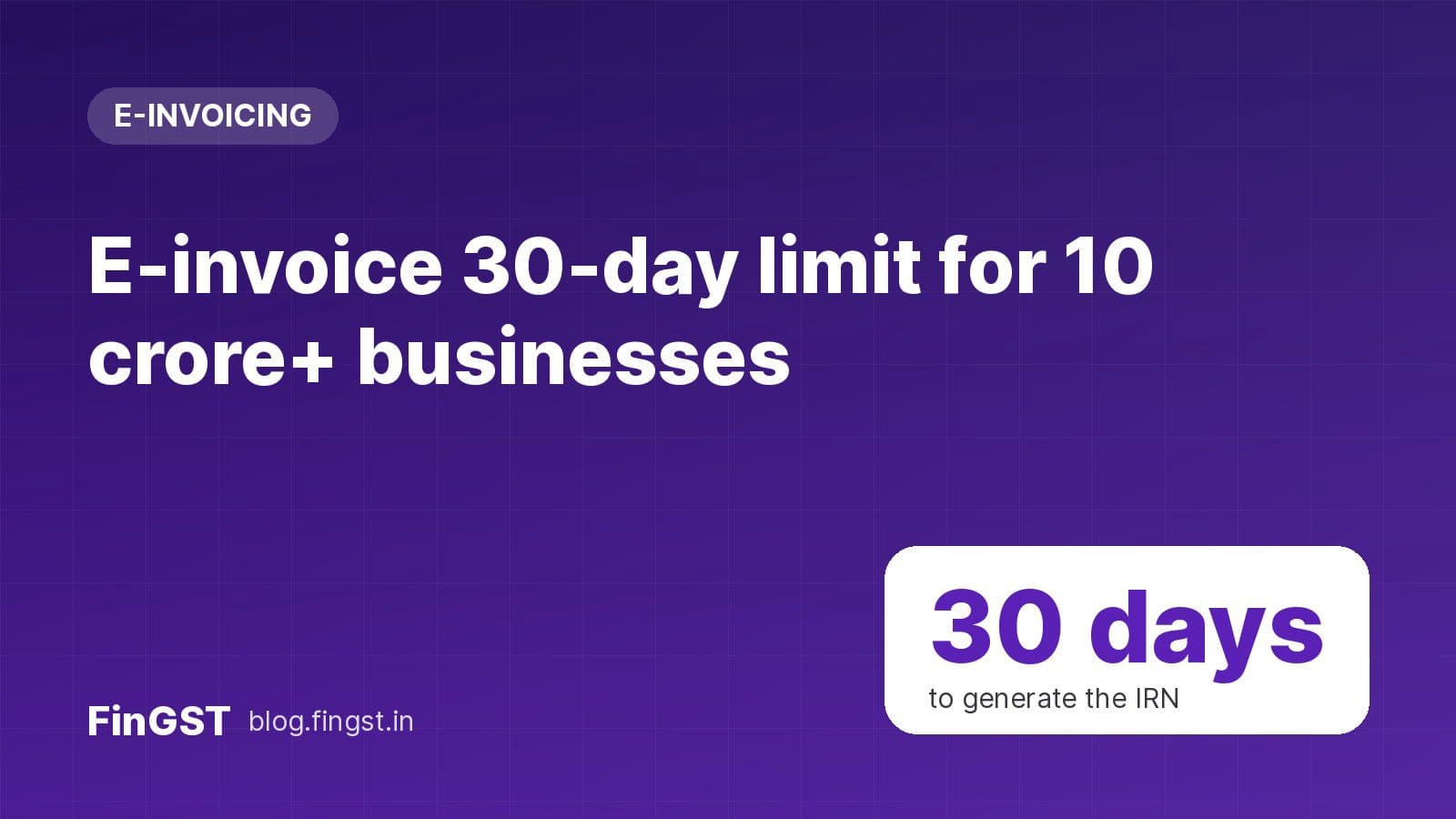
Since 1 April 2025, taxpayers with AATO of ₹10 crore or more cannot report an invoice to the Invoice Registration Portal (IRP) more than 30 days after the invoice date. Before that, the limit applied only at ₹100 crore and above.
So for an invoice dated 1 November 2026, the last day to generate the IRN is 1 December 2026. After that, the IRP rejects it.
What happens if you miss it
- An e-invoice-mandated business cannot issue a valid invoice without an IRN.
- Your customer can't claim ITC, because the invoice won't auto-populate correctly into their GSTR-2B.
- The supply is still taxable, so you have to pay the tax anyway, and you risk penalties for an invalid invoice.
Which documents it covers
The limit applies to invoices and credit notes reported on the IRP. Check the latest GSTN advisory for the current scope, especially for debit notes.
How to stay compliant
- Generate the IRN when you invoice, not at month-end. Integrate your ERP or billing software with an IRP through APIs.
- Watch the backdating risk. Invoices created late in the system but dated earlier are the usual culprits.
- Use the backup IRPs if the main IRP is down. There are several, and they share data.
- Run a weekly exception report of invoices without an IRN.
Checking your AATO
AATO is calculated on PAN, across all GSTINs, for the previous financial year. The portal shows it on your dashboard. If it changed after 1 April, check whether the 30-day limit now applies to you.
Who must generate e-invoices at all
- Aggregate turnover above ₹5 crore in any FY from 2017-18. Once you cross it, e-invoicing applies even if turnover later falls.
- It covers B2B supplies, exports, supplies to SEZs, and credit and debit notes. B2C invoices are not covered, though large businesses need a dynamic QR code on them.
Exempt: SEZ units (not developers); insurance companies, banks, NBFCs and other financial institutions; GTAs; passenger transport services; cinema admission (multiplex screens); and government departments and local authorities.
How e-invoicing works
- Raise the invoice in your ERP or billing software in the INV-01 schema.
- Upload the JSON to the IRP.
- The IRP returns an IRN (a 64-character hash), a signed QR code and an acknowledgement number.
- The data flows to your GSTR-1 and, with transport details, to the e-way bill.
- Print the QR code on the invoice.
An IRN can be cancelled within 24 hours, but not edited. After that, issue a credit note. Two-factor authentication (OTP) is mandatory for logging in to the e-invoice portals.
Penalties
- Invoice without an IRN: treated as not issued. Penalty up to ₹10,000 per invoice, or the tax due, whichever is higher.
- Your buyer loses ITC on it.
Read e-way bill rules next.
FAQs
What is the e-invoice limit in 2026? ₹5 crore of aggregate turnover in any year from 2017-18.
Is e-invoicing required for B2C? No, but large businesses need a dynamic QR code on B2C invoices.