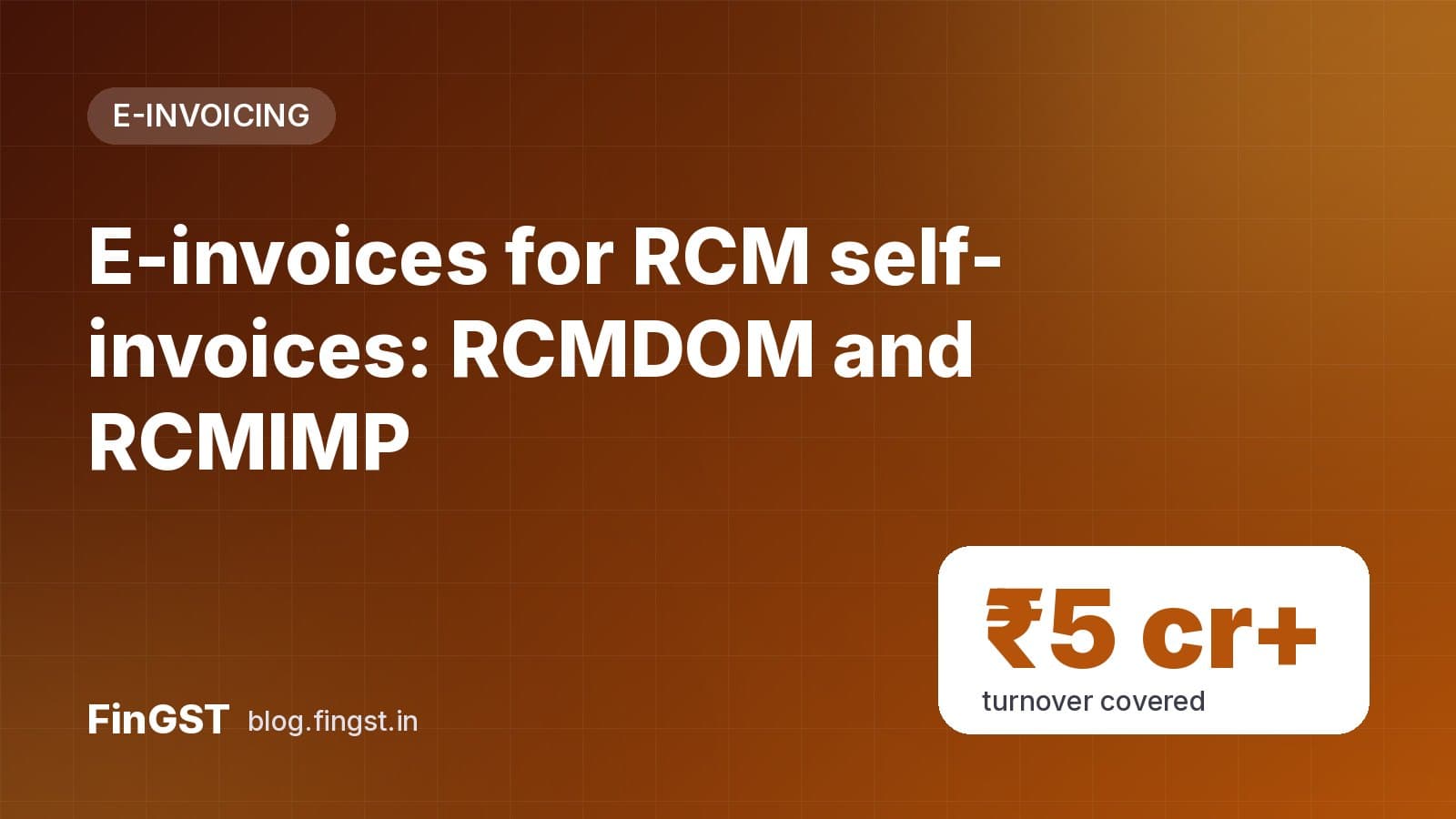
Until now, e-invoicing has been about the supplier reporting an invoice and getting an IRN (Invoice Reference Number). A new change brings self-invoices under reverse charge (RCM) into e-invoicing as well, so the buyer will report them.
This follows a recommendation of the 57th GST Council meeting. The system changes are ready for testing, and the go-live date will be announced separately.
What is a self-invoice under RCM?
Under reverse charge, the recipient pays the GST instead of the supplier. When you buy notified goods or services from an unregistered supplier, or import services from a supplier outside India, you issue an invoice to yourself — a self-invoice — and pay the tax under RCM.
What is changing
Two new supply types are being added to the e-invoice system:
| Supply type | Used for |
|---|---|
| RCMDOM | Self-invoices for specified domestic supplies received from unregistered persons, where you pay tax under RCM |
| RCMIMP | Self-invoices for import of services from suppliers outside India, where you pay tax under RCM |
When you report such a self-invoice through an authorised IRP and choose RCMDOM or RCMIMP, an IRN is generated for it, just like a normal e-invoice.
Who will be covered
The facility is meant for registered taxpayers with aggregate annual turnover (AATO) of ₹5 crore and above — the same threshold that applies to e-invoicing today.
The exact scope and the date from which this becomes mandatory will be set by government notification. Until that notification is issued, nothing changes in how you file.
Current status
- The new supply types are live in the sandbox of all six IRPs (NIC IRP-1 and IRP-2, Cygnet, Clear, EY and IRIS), with the same validations across all of them.
- NIC IRP-1 will publish a detailed release note with the technical specifications and validation codes.
- GSTN and the IRPs will hold a webinar on the new functionality; details will follow.
- The production go-live date will be announced later.
A simple example
Suppose a company with turnover of ₹8 crore pays a foreign provider for a software subscription. That is an import of services, so the company pays IGST under reverse charge and issues a self-invoice.
- Today: the self-invoice is created in the company's books and the tax is paid in GSTR-3B.
- After go-live: the same self-invoice is also reported to an IRP with supply type RCMIMP, and an IRN is generated for it.
The same logic applies to a notified purchase from an unregistered supplier — that self-invoice would use RCMDOM.
How to prepare
- Check your turnover. If your AATO is ₹5 crore or more, this will apply to you.
- List your RCM transactions. Which purchases from unregistered suppliers and which imported services do you self-invoice today? How many a month?
- Talk to your ERP or billing software provider about support for RCMDOM and RCMIMP, and when they will test it in the sandbox.
- Plan the process. Self-invoices will need the same discipline as sales e-invoices: correct details, issued on time, and reconciled with your GSTR-3B RCM liability.
- Watch for the notification with the start date. The FinGST app alerts you when new CBIC notifications are published.
Quick FAQ
Do I need to do anything today? Only prepare. Reporting becomes mandatory from the date set in the notification.
I'm below ₹5 crore. Does this apply to me? Based on the advisory, no — it follows the current e-invoicing threshold, subject to the final notification.
Will the IRP portals behave differently? No. GSTN says the validations and codes will be the same across all six IRPs.
Official source
- GSTN: e-Invoicing facility for recipient generated self-invoices under RCM (RCMDOM and RCMIMP)
- e-Invoice portal
- NIC e-Invoice API sandbox
Related: 57th GST Council meeting — key decisions explained.