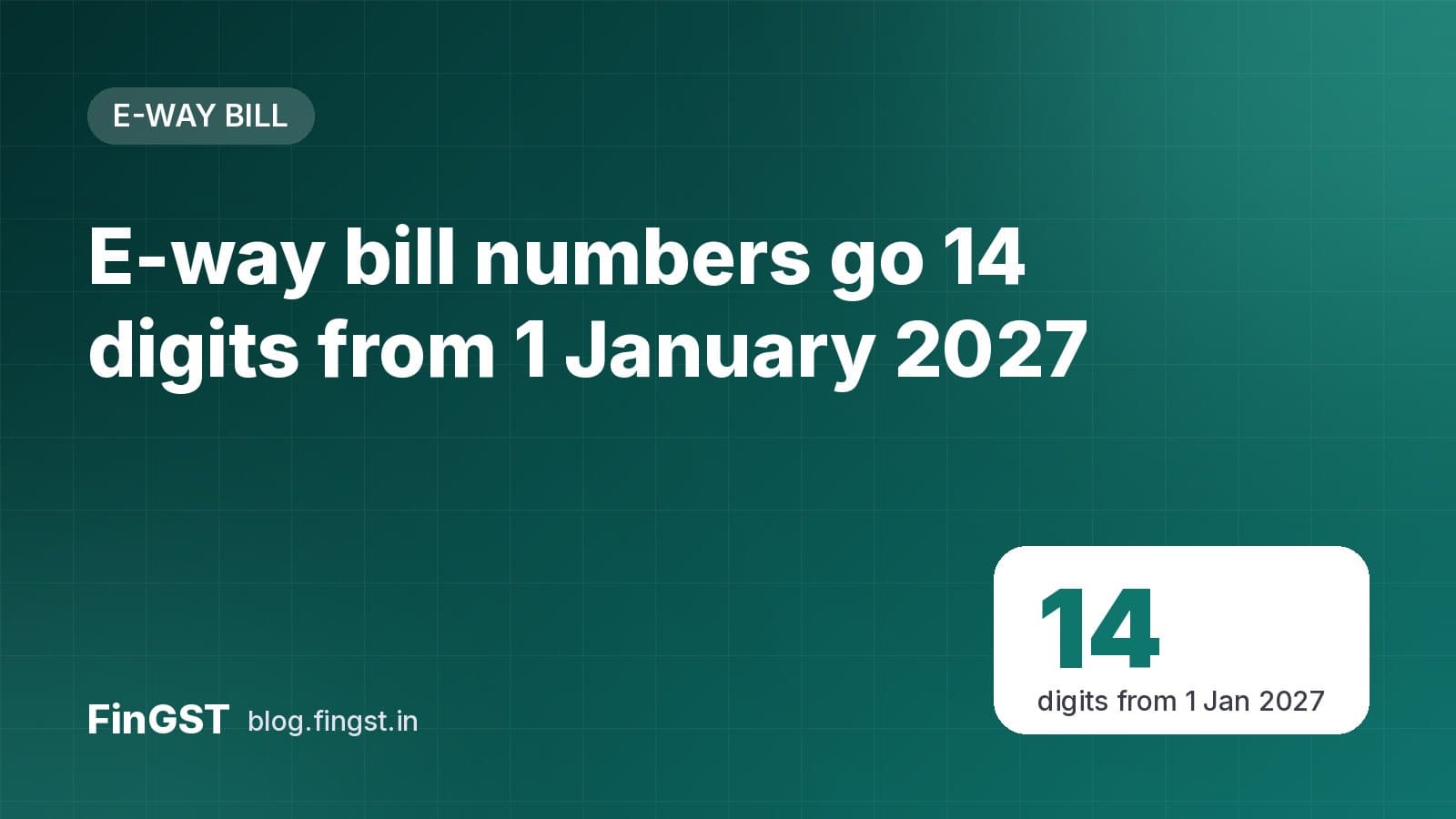
GSTN has announced that e-way bill numbers will become longer from 1 January 2027. The reason is volume: so many e-way bills are generated that the current numbering capacity is expected to run out.
The change is small on paper, but any software or form that assumes a 12-digit number will break. Here is what changes and how to prepare.
What is changing
| Document | Current format | From 1 January 2027 |
|---|---|---|
| E-way bill number (EWBN) | 12 digits | 14 digits |
| Consolidated e-way bill number | 10 digits | 11 digits |
Nothing else about the e-way bill rules changes with this advisory — the thresholds, validity and the documents you need stay the same. Only the length of the number changes.
Who is affected
GSTN has asked all stakeholders to prepare:
- Taxpayers who generate e-way bills, especially through software or the API
- Transporters who record or verify e-way bill numbers
- GSPs, ERP and billing software providers (Tally, SAP, custom systems)
- API integrators who store or validate e-way bill numbers
If you only generate e-way bills by hand on the e-way bill portal and don't store the number anywhere else, you have very little to do. If the number flows into your invoices, ERP, transport documents or reports, read on.
Checklist: what to update before 1 January 2027
- Database fields — any column that stores the EWB number as exactly 12 characters, or as a number that can't hold 14 digits, needs to be widened.
- Validation rules — forms or APIs that reject numbers that are not exactly 12 digits must accept 14 (and 11 for consolidated EWBs).
- Print layouts — invoice, delivery challan and LR templates that print the EWB number in a fixed-width box need more space.
- Search and matching — reconciliation reports that match e-way bills with invoices, or that look up numbers by length or pattern, should handle both formats, because older 12-digit bills will still appear in your records.
- Barcodes and QR codes — if your own documents encode the EWB number, test that the longer number still scans.
- Ask your software vendor which version supports 14-digit numbers, and plan the update before the year-end rush.
Test in the sandbox first
GSTN says the change will be released in the e-way bill sandbox shortly for testing, with details on the e-way bill portal. If you or your vendor use the API, test there well before the deadline.
GSTN's own words: stakeholders should ensure system readiness well before 1 January 2027 to avoid any disruption to e-way bill operations.
A blocked e-way bill means goods can't move, so treat this like a deadline, not a nice-to-have.
A simple timeline to get ready
| When | What to do |
|---|---|
| November | Ask your billing/ERP vendor when 14-digit support ships; list every place the EWB number is stored or printed |
| As soon as the sandbox is live | Test generation, printing, storage and reconciliation with 14-digit numbers |
| December | Install the updated software and train the team that generates e-way bills |
| 1 January 2027 | Generate the first live e-way bills and check they print and save correctly |
Leaving this to the last week of December is risky: year-end is when transport volumes and software updates both peak.
Quick FAQ
Do I need to regenerate old e-way bills? No. The advisory is about the numbering format going forward; it doesn't ask anyone to regenerate existing bills.
Does the e-way bill threshold or validity change? Not with this advisory. It only changes the length of the numbers.
Where will the technical details be published? On the e-way bill portal, along with the sandbox release.
Stay ahead of GST changes
The FinGST app alerts you when GSTN publishes advisories like this one, and the free GST tools on fingst.in help with day-to-day calculations.